What started out as a short project refresher after the mammoth undertaking of the “Dream Spaces” video slowly became another project on which I obsessed over the details. There’s always a temptation to let a generated shot or sequence be ‘good enough’ but I think the key to making an ai video is to keep generating until its as close to perfect as you can get.
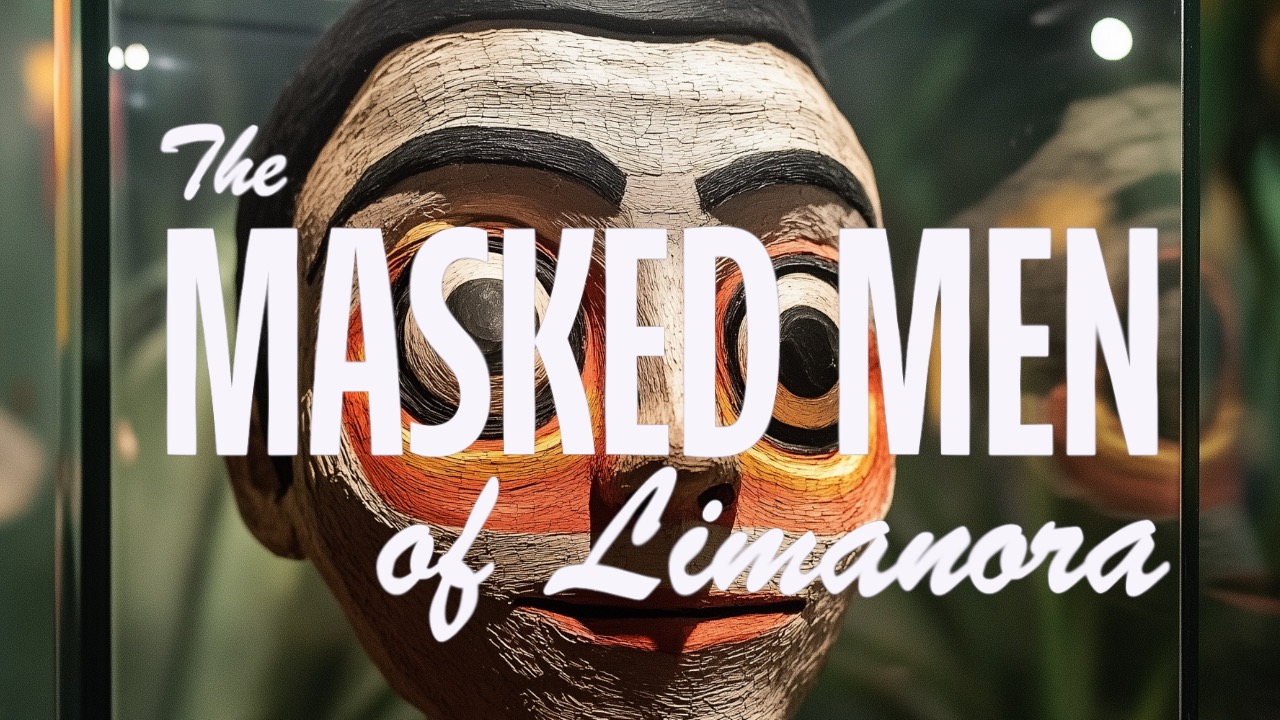
“The Masked Men of Limanora” is a return to the island, this time in the form of a vintage documentary style I’ve always enjoyed – those odd anthropological films made mid-century, with stilted narrations and a music track for accompaniment. The titles are styled on a documentary about the production of turpentine in the US from 1940 that I found on YouTube. I also sampled the narrator’s voice for true period accuracy.
The intention with “Masked Men” was to tell a story that evoked some of the island’s history with a ‘contemporary view’ of its current state [albeit one already outdated]. The idea of the men and their masks was based on a random image generation I did for fun, and then thought of a story around it. Both of my technical advisers told me that it reminded them of Frank Sidebottom, the 90s era English musical hall revivalist who wore a similar mask, and the movie ‘Frank’ – which fictionalised that story into a weird tale of identity – so you’ll see a fair bit of variation on the masks, but hey, I’m happy to make that connection.
Overall, I used pretty much the same production model as in previous videos [image generation in MidJourney, video generation via Runway, edit and mix with sound effects courtesy of the free-to-use BBC Sound Effects library]. But there were two notable additions this time.
I used ChatGPT to help create a language for Limanora. Based in part on Portuguese, English and Czech, the ai quizzed me on a variety of aspects of a constructed language – including questions about purpose, phonetics & pronunciation, grammar & sentence structure, vocabulary, writing system, culture & history and simplicity vs. complexity – each of which I answered – and then it proceeded to create, from scratch, something unique to the world of Limanora. In the video, you’ll notice some signs and posters with Limanoran text. I had thought to maybe include some spoken examples of the language in the parts that mention the revolution, but I think I’ll save that for another project.
The other aspect of the project that’s a bit different is that I again used Udio, the music generating ai, to produce the score. I had used Udio tracks in “Dream Spaces” but this was the first time that I used one track for an entire video, and I think the style and overall instrumental quality of the music really suits the aesthetic. One of the aspects of ai music that marks it as generated is the often illogical and counterintuitive changes in structure that occur. If you don’t listen too closely, it’s hard to detect because the ai does a good job of averaging a musical style into something that sounds credible. However, Udio gives you the option of constructing music tracks using 30 second sections, generated one at a time. By trial an error you can construct a piece of music that makes sense and sounds a lot less artificial than just getting the ai to smash out a 2 min track.

 sciencefictional.net